Introduction
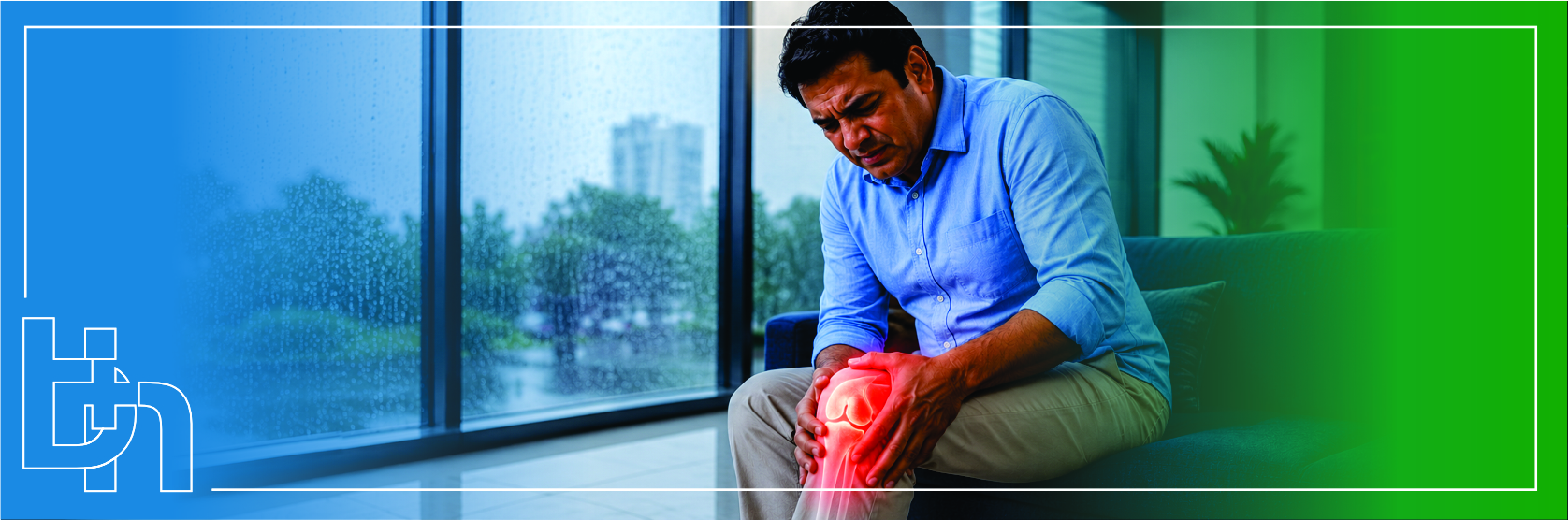
If your knees ache more when it rains, you're not alone. Thousands of Mumbai residents report worsening knee pain during monsoon — and the science backs them up. Changes in atmospheric pressure directly affect joint fluid and nerve sensitivity.
A Knee Pain Specialist in Mumbai can diagnose the underlying cause and provide lasting relief.
What Causes Knee Pain During Monsoon?
Monsoon-related knee pain is not a new condition — it's an exacerbation of existing joint problems like arthritis, ligament weakness, or cartilage wear triggered by weather changes.
The drop in barometric pressure causes joint tissues to expand slightly, increasing pressure on already-sensitive nerves and causing pain.
Causes & Risk Factors
Who is most at risk for monsoon knee pain?
- Osteoarthritis — the most common cause; affects millions in India over 50
- Rheumatoid Arthritis — autoimmune inflammation flares with cold and humidity
- Previous knee injuries — ACL tears, meniscus damage, old fractures
- Obesity — every extra kg adds 4x load on knee joints
- Vitamin D and Calcium deficiency — weakens bone and joint support
- Sedentary lifestyle — weak thigh muscles increase knee stress
- Age above 50 — cartilage naturally wears with age
Symptoms
Monsoon knee pain can present in several ways:
- Morning stiffness lasting more than 30 minutes — hallmark of arthritis
- Swelling or warmth around the knee joint
- Grinding or clicking sensation (crepitus) on movement
- Pain worsening with stairs, squatting, or prolonged sitting
- Limited range of motion — difficulty fully bending or straightening
- Muscle weakness in the thigh and calf
When To Visit A Doctor?
See an Orthopedic Doctor in Mumbai if:
- Knee pain persists for more than a week without improvement
- The joint is visibly swollen, red, or warm to touch
- Pain prevents normal walking or climbing stairs
- You have a history of knee injury or previous surgery
- Night pain disrupts your sleep regularly
- You are over 50 with worsening bilateral knee pain
Diagnosis
At Bhatia Hospital's Orthopedic department, diagnosis is thorough and evidence-based:
- X-Ray of Knee (Weight-bearing AP & Lateral) — assesses joint space, osteophytes, alignment
- MRI Knee — evaluates cartilage, ligaments, meniscus, and soft tissue in detail
- Serum Uric Acid — to rule out gout as a cause of sudden acute pain
- RA Factor & Anti-CCP — for suspected Rheumatoid Arthritis
- Vitamin D3 and Calcium levels — frequently low in urban Mumbai patients
- Synovial Fluid Analysis — if significant joint effusion (swelling with fluid) is present
- Gait Analysis — assesses walking pattern and biomechanical abnormalities
Treatment
Treatment is staged from conservative to surgical based on severity:
Conservative (Most Patients)
- NSAIDs (Ibuprofen, Diclofenac) — for acute pain and inflammation
- Topical gels (Diclofenac, Ketoprofen) — lower systemic side effects
- Physiotherapy — quadriceps strengthening is the cornerstone of knee OA management
- Knee bracing and taping — for patellar pain and instability
- Vitamin D and Calcium supplementation — for deficient patients
- Weight management — reduces mechanical load on joints
Interventional
- Intra-articular Corticosteroid Injection — for acute inflammatory flares
- Hyaluronic Acid (Viscosupplementation) — lubricates the joint in moderate OA
- PRP (Platelet-Rich Plasma) Injection — emerging regenerative option
Surgical
- Arthroscopy — minimally invasive for meniscal tears and loose bodies
- High Tibial Osteotomy (HTO) — for younger patients with medial compartment OA
- Total Knee Replacement (TKR) — for severe Grade 3/4 osteoarthritis
Prevention
Keep your joints healthy through the monsoon and beyond:
- Stay physically active — swimming and cycling are low-impact alternatives
- Maintain a healthy weight — the single most effective prevention strategy
- Vitamin D supplementation — critical in Mumbai where sun exposure is limited in monsoon
- Wear supportive footwear — avoid flat slippers and high heels
- Practice yoga and knee-strengthening exercises under guidance
Why Choose Bhatia Hospital?
Bhatia Hospital is South Mumbai's leading orthopedic hospital, offering everything from conservative management to advanced joint replacement under one roof.
- Experienced Knee and Joint Replacement Specialists
- Advanced MRI and digital X-Ray diagnostics on-site
- Dedicated physiotherapy and rehabilitation centre
- Minimally invasive surgical techniques for faster recovery
Troubled by knee pain this monsoon? Consult Bhatia Hospital's Orthopaedic Specialist today.
FAQs
Q1. Why does knee pain get worse during monsoon?
The drop in barometric pressure during monsoon causes joint tissues to expand, increasing pressure on nerves and aggravating existing arthritis or injuries.
Q2. When should I see an orthopedic doctor for knee pain?
If pain persists for more than a week, the joint swells, or movement is restricted, consult an orthopedic specialist without delay.
Q3. Can knee pain be cured without surgery?
Yes — most cases of mild to moderate osteoarthritis respond well to physiotherapy, weight loss, and medications. Surgery is a last resort.
Q4. Which exercise is best for knee pain?
Quad sets, straight leg raises, and cycling are excellent low-impact exercises. Always start under physiotherapy guidance.
Q5. Is knee replacement surgery painful?
Modern total knee replacement is performed under spinal anaesthesia. With multimodal pain management, most patients have minimal discomfort post-operatively.